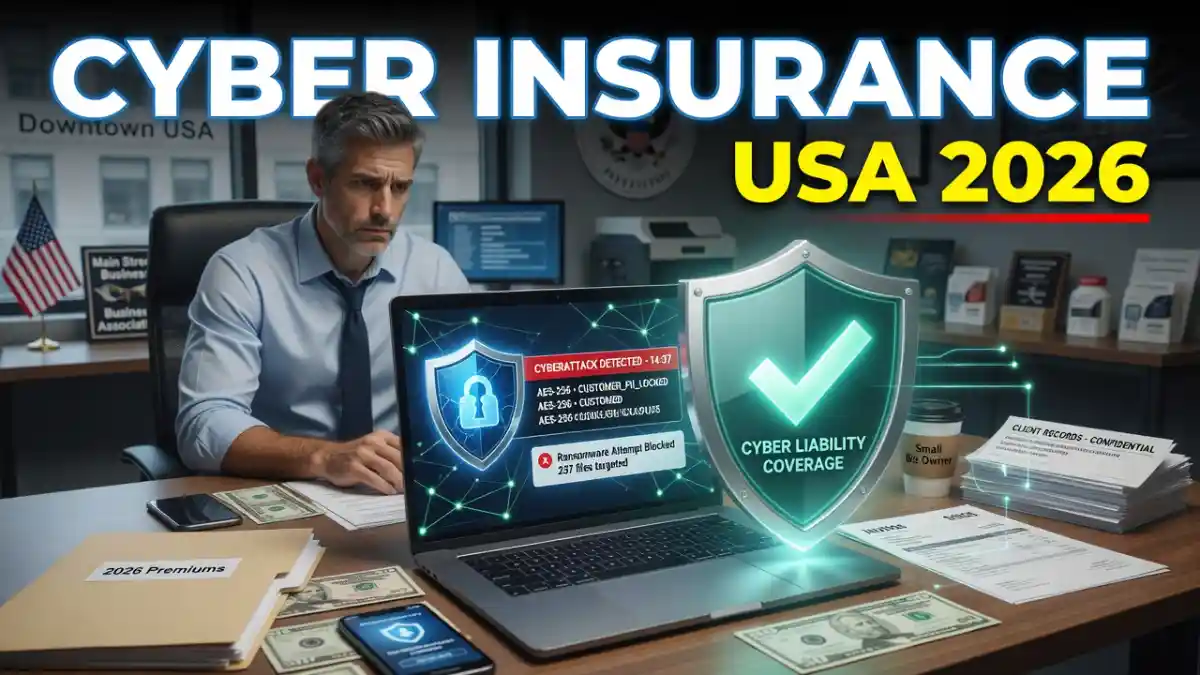
Cyber Liability Insurance for Small Businesses in USA: Cyberattacks are no longer a problem limited to large corporations. Small businesses across the United States are also facing risks from data breaches, ransomware, phishing attacks, stolen customer information and other cyber incidents.
For many small businesses, a single serious cyber incident can create significant expenses. These may include data recovery, legal costs, customer notification, system restoration and business interruption losses.
That is where Cyber Liability Insurance can help.
Cyber liability insurance, also called cyber insurance, is designed to help businesses manage certain financial losses associated with covered cyber incidents. But coverage, exclusions, limits and premiums can vary significantly between insurance companies and policies.
In this guide, we explain what cyber liability insurance covers, how much it may cost, who needs it and what small-business owners should consider before buying a policy.
What Is Cyber Liability Insurance?
Cyber liability insurance is a type of business insurance designed to provide financial protection against certain cyber-related risks.
Depending on the policy, coverage may help with expenses resulting from incidents such as:
- Data breaches
- Ransomware attacks
- Malware infections
- Phishing and social engineering incidents
- Cyber extortion
- Customer data exposure
- Network security failures
- Privacy-related claims
- Certain business interruption losses
- Legal defense and regulatory expenses
The exact protection depends on the policy. Some policies may also provide access to cybersecurity professionals, forensic investigators, attorneys and public-relations specialists after a covered incident.
Why Do Small Businesses Need Cyber Insurance in 2026?
Small businesses often handle valuable information such as customer names, email addresses, payment information, employee records and business documents.
A cyberattack can therefore create several different types of financial exposure.
For example, a business may need to investigate what happened, secure its systems, notify affected customers, restore data and deal with potential legal claims.
Cyber liability insurance can potentially help cover some of these costs when they fall within the policy’s coverage.
However, insurance should not be considered a replacement for cybersecurity. Businesses should still use strong passwords, multi-factor authentication, employee training, secure backups and other security measures.
What Does Cyber Liability Insurance Cover?
Coverage varies by insurer and policy, but cyber insurance commonly focuses on two broad areas: first-party coverage and third-party coverage.
First-Party Cyber Coverage
First-party coverage generally relates to losses suffered directly by the insured business.
Depending on the policy, this may include:
Data Breach Response
A covered breach can require investigation and response. Some policies may help pay for forensic services, notification expenses and other response costs.
Cyber Extortion and Ransomware
Certain policies may provide coverage related to cyber extortion or ransomware incidents, subject to policy terms, exclusions and applicable law.
Data Recovery
If business data is damaged or encrypted during a covered cyber incident, a policy may help with eligible data restoration expenses.
Business Interruption
A serious cyber incident can temporarily prevent a company from operating normally. Some cyber policies may provide coverage for qualifying income losses and extra expenses.
Crisis Management
Certain policies can help businesses manage the immediate response to a significant cyber incident, including specialized professional services.
Third-Party Cyber Liability Coverage
Third-party coverage generally relates to claims made against the business by customers, clients or other parties.
Depending on the policy, this can include:
- Privacy liability claims
- Network security liability
- Legal defense expenses
- Certain regulatory proceedings
- Claims involving compromised customer information
Again, the exact coverage depends on the policy language.
How Much Does Cyber Liability Insurance Cost for a Small Business?
There is no single price for cyber liability insurance in the USA.
The premium can depend on several factors, including:
- Business size
- Industry
- Annual revenue
- Number of employees
- Amount and type of sensitive data handled
- Cybersecurity controls
- Previous claims
- Coverage limits
- Deductible
- Policy features
- Business location
A small online business with limited customer data may have a very different premium from a healthcare company, financial business or e-commerce company handling large volumes of sensitive information.
Because of these differences, business owners should compare quotes rather than relying on a generic online estimate.
What Factors Affect Cyber Insurance Premiums?
Insurance companies may evaluate a business’s cybersecurity practices before providing coverage.
Important factors can include:
Multi-Factor Authentication
MFA can provide an additional layer of protection beyond passwords and may be an important underwriting consideration.
Employee Security Training
Employees are often targeted through phishing and social-engineering attacks. Regular security awareness training can help reduce certain risks.
Backup Systems
Businesses should maintain reliable backups and ensure that critical data can be restored if systems are compromised.
Endpoint Security
Security tools for computers, servers and other connected devices can form part of a company’s overall cybersecurity strategy.
Access Controls
Businesses should limit access to sensitive systems and information to employees who actually need it.
Incident Response Plan
Having a documented plan for responding to a cyberattack can help a business react more quickly when something goes wrong.
Who Should Consider Cyber Liability Insurance?
Cyber insurance can be particularly relevant for businesses that:
- Store customer information
- Accept online payments
- Operate e-commerce websites
- Maintain employee data
- Provide online services
- Store information in cloud systems
- Depend heavily on computer networks
- Handle confidential client information
- Collect sensitive personal information
Some businesses may also face contractual requirements from customers or business partners requiring certain insurance coverage.
Cyber Liability Insurance vs General Liability Insurance
These two types of insurance are not necessarily interchangeable.
General liability insurance generally focuses on traditional business risks such as bodily injury, property damage and certain personal or advertising injury claims.
Cyber liability insurance focuses specifically on covered cyber and privacy-related risks.
A business may need both types of coverage because they address different categories of risk.
If you are reviewing your broader business insurance needs, it can also be useful to understand how commercial auto and other business policies fit into your overall insurance strategy.
What Is a Cyber Insurance Deductible?
A deductible is the amount the insured business may have to pay before the insurance company begins paying covered losses, subject to the policy terms.
For example, if a policy has a $2,500 deductible and a covered claim produces $20,000 in eligible losses, the policy may respond to the amount above the applicable deductible.
The actual calculation depends on the policy and type of loss.
A lower deductible may sometimes mean a higher premium, while a higher deductible may reduce the premium but increase the business’s potential out-of-pocket cost.
How Much Cyber Insurance Coverage Does a Small Business Need?
There is no universal coverage limit that works for every company.
A business should consider:
- The amount of customer data it stores
- Annual revenue
- Potential business interruption losses
- Industry-specific risks
- Contractual requirements
- Regulatory exposure
- Cost of restoring systems
- Potential legal expenses
A small company should avoid selecting a coverage limit simply because it is the cheapest option.
The goal should be to balance premium costs with the financial impact of a realistic cyber incident.
What Does Cyber Insurance Usually Exclude?
Cyber policies can contain important exclusions and conditions.
Depending on the policy, exclusions may involve:
- Certain known security vulnerabilities
- Intentional acts
- Unapproved payments
- Certain infrastructure failures
- Prior incidents
- Specific types of social-engineering losses
- Certain regulatory penalties
- War or nation-state-related events
- Losses outside the policy’s definition of a covered cyber event
This is why reading the policy language is extremely important.
Two policies can have similar premiums but provide significantly different protection.
How to Choose the Best Cyber Liability Insurance for Your Business
When comparing cyber insurance policies, don’t focus only on the monthly or annual premium.
Look at the complete coverage package.
1. Compare Coverage Limits
Check the maximum amount the insurer may pay for covered losses.
2. Check the Deductible
Understand how much your business may have to pay out of pocket.
3. Review Exclusions
Pay particular attention to situations that are not covered.
4. Look at Incident Response Services
Some policies provide access to specialized professionals after a cyber incident.
5. Check Business Interruption Coverage
If your company depends heavily on digital systems, interruption coverage can be an important consideration.
6. Review Social Engineering Coverage
Fraud involving phishing, impersonation or fraudulent payment instructions may require specific coverage or endorsements.
7. Compare Multiple Quotes
Prices and coverage can differ significantly between insurers, so comparing multiple options can help businesses find a policy that fits their needs.
Cyber Insurance for Different Types of Small Businesses
Cyber risks can vary significantly by industry.
Cyber Insurance for E-Commerce Businesses
Online stores process customer information and payments, making cybersecurity an important part of risk management.
Cyber Insurance for Professional Services
Consultants, agencies, accountants and other professional businesses may store sensitive client information and depend on cloud-based systems.
Cyber Insurance for Healthcare Businesses
Healthcare businesses can handle highly sensitive patient information and may face particularly significant privacy and security risks.
Cyber Insurance for Financial Businesses
Companies handling financial information may face additional cybersecurity and compliance considerations.
Cyber Insurance for Contractors
Contractors increasingly rely on digital systems, email, cloud storage and online payment platforms. Cyber coverage can therefore be relevant even for businesses that do not consider themselves technology companies.
Cyber Liability Insurance vs Cybersecurity
It’s important to understand the difference.
Cybersecurity is about preventing and reducing cyber threats.
Cyber liability insurance is about managing certain financial consequences after a covered incident.
A strong cybersecurity program can potentially reduce the probability or severity of an attack, while insurance may provide financial support for eligible losses when a covered event occurs.
The two should work together rather than being treated as alternatives.
How to Apply for Cyber Liability Insurance
The application process can involve questions about your business and cybersecurity practices.
An insurer may ask about:
- Annual revenue
- Number of employees
- Industry
- Customer data
- Payment processing
- Cloud services
- MFA
- Backup systems
- Antivirus and endpoint protection
- Previous cyber incidents
- Security policies
Accurate answers are important. Providing incomplete or inaccurate information can create problems when a claim is made.
Tips to Reduce Cyber Insurance Costs
There is no guaranteed way to obtain a lower premium, but businesses can strengthen their risk profile by improving cybersecurity practices.
Consider:
- Enabling multi-factor authentication
- Regularly updating software
- Training employees about phishing
- Maintaining secure backups
- Limiting administrative access
- Using strong password policies
- Monitoring suspicious activity
- Creating an incident response plan
- Reviewing cyber risks regularly
Better security may also help reduce the potential impact of an incident.
Frequently Asked Questions
Is cyber liability insurance worth it for a small business?
It can be valuable for businesses that rely on digital systems or handle customer and employee information. Whether it is worthwhile depends on the company’s specific risk exposure and financial situation.
Is cyber insurance mandatory in the USA?
There is no universal federal requirement that every small business carry cyber liability insurance. However, particular industries, contracts or business relationships may impose insurance requirements.
Does general liability insurance cover cyberattacks?
Traditional general liability insurance may not provide the specialized protection a business expects for cyber incidents. Businesses should review their existing policy and discuss cyber risks with a qualified insurance professional.
Does cyber insurance cover ransomware?
Some cyber insurance policies can provide coverage for certain ransomware-related losses, but coverage depends on the policy, exclusions, conditions and applicable law.
Can a small business buy cyber insurance?
Yes. Cyber insurance products are available for businesses of different sizes, although eligibility, coverage and pricing vary.
What is the difference between cyber insurance and data breach insurance?
The terms are sometimes used interchangeably, but cyber insurance can provide broader protection than coverage focused only on data breaches. Always review the specific policy wording to understand what is covered.
Final Thoughts
Cyber threats are becoming an important business risk for companies of all sizes. For a small business, a serious cyber incident can potentially create expenses far beyond the initial technical problem.
Cyber Liability Insurance for Small Businesses can provide an additional layer of financial protection for certain covered cyber-related losses.
However, the best policy is not necessarily the cheapest one. Business owners should compare coverage limits, deductibles, exclusions, incident-response services and policy conditions before making a decision.
Most importantly, insurance should work alongside strong cybersecurity practices rather than replace them.
Financial Disclaimer
This article is for general informational and educational purposes only. Insurance coverage, pricing, eligibility, exclusions and legal requirements vary by insurer, business type, state and individual circumstances. This article is not insurance, legal or financial advice. Always review the actual policy documents and consider speaking with a licensed insurance professional before purchasing coverage.
Related Reading
- Best Business Insurance for Small Businesses in USA 2026
- Best Commercial Auto Insurance for Small Business in USA 2026
- Best Professional Liability Insurance in USA 2026
- Best Business Lines of Credit in USA 2026
- Best Business Credit Cards for Small Business Owners in USA 2026

Suchna Hindi is a Professional News Platform. Here we will provide you only interesting content, which you will like very much. We’re dedicated to providing you the best of News, with a focus on dependability and News Website.